


July 31, 2026
Commercial painting involves much more than selecting the right color. While traditional commercial paint is suitable for many applications, some environments place greater demands on walls, floors, ceilings, and structural components.
Heavy traffic, moisture, chemicals, UV exposure, and strict building requirements can all affect how well a standard paint system performs over time. Specialty coatings are designed to address these challenges in facilities such as hospitals, schools, warehouses, office buildings, parking garages, and manufacturing plants.
At Cochran & Mann, specialty coatings are one part of our commercial painting and wallcovering services. Every project begins with understanding how the building will be used, the conditions it will face, and the goals of the owner, facility manager, architect, or general contractor. That information helps guide discussions about coating systems that may be appropriate for the project and its long-term maintenance goals.
What Are Specialty Coatings?
Specialty coatings are high-performance systems designed for environments where traditional architectural paint may not provide enough durability or protection. Rather than serving only a decorative purpose, these coatings are formulated to resist conditions such as moisture, abrasion, chemical exposure, corrosion, UV exposure, and extreme heat.
Choosing the right coating depends on several factors, including:
-
Building use
-
Surface material
-
Environmental conditions
-
Traffic levels
-
Maintenance requirements
-
Applicable building codes
Because every commercial building has unique needs, specialty coatings are often specified during the design process and applied by experienced commercial painting contractors.
Common Types of Specialty Coatings
Epoxy and Urethane Coatings
Epoxy and urethane coatings are among the most widely used specialty coatings in commercial and industrial facilities. They create a durable, seamless surface that performs well in demanding environments where standard paint or flooring systems may wear quickly.
These coatings are commonly used in:
- Healthcare facilities
- Laboratories
- Warehouse
- Manufacturing plants
- Mechanical rooms
- Parking structures
When installed over properly prepared concrete, epoxy and urethane systems can provide a durable finish that's easier to maintain while helping protect the underlying surface over time.
Project Example: At Holy Cross Hospital in Silver Spring, Maryland, Cochran & Mann partnered with Whiting-Turner to renovate 180 patient rooms across two vacant floors in just three weeks, converting the space into a dedicated COVID-19 unit during the pandemic. Bathrooms and wet areas were finished with a PPG acrylic epoxy semi-gloss system chosen specifically to withstand humidity and the constant disinfecting cleaning schedules hospital staff require, while crews worked ten-hour days, six days a week to hit a critical deadline.
High-Performance Corrosion-Resistant Coatings
Steel structures and exposed metal surfaces are continually exposed to moisture, humidity, and environmental contaminants. Corrosion-resistant coatings create a protective barrier that helps reduce wear caused by everyday exposure and are commonly specified for parking garages, manufacturing facilities, transportation projects, and commercial buildings exposed to harsh conditions.
These systems are often applied to:
-
Structural steel
-
Mechanical equipment
-
Industrial piping
-
Railings
-
Stairwells
-
Exterior metal surfaces
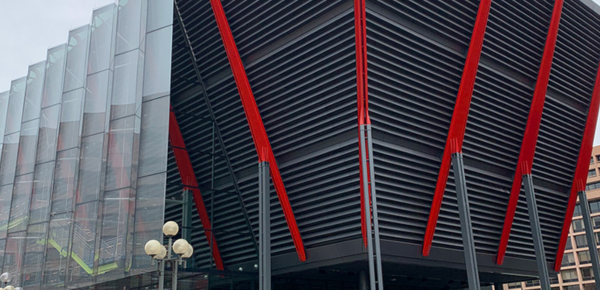
Project Example: At the Exelon Building in Baltimore's Harbor Point, Cochran & Mann applied a multi-step Tnemec coating system — Hi-Build Series V69 epoxy, Endurashield 1095 urethane, and a Fluoronar Series 1071V fluoropolymer topcoat — to structural steel canopies for building owner Armada Hoffler. Working through a Baltimore winter into early summer, crews stayed on call to coat exposed steel immediately after welding and grinding during on-site fabrication, all while meeting the strict application windows and multi-decade warranty requirements specified by the manufacturer.
Elastomeric and Waterproofing Coatings
Water intrusion is one of the most common causes of long-term building damage. Elastomeric and acrylic waterproofing coatings are designed to create a flexible barrier that helps limit moisture intrusion while allowing the coating to expand and contract with seasonal temperature changes.
These systems are commonly applied to:
- Concrete
- Masonry
- Stucco
- Exterior walls
- Parking structures
Unlike traditional exterior paint, elastomeric coatings can bridge small hairline cracks while maintaining flexibility. When paired with proper surface preparation, these systems are designed to help protect exterior surfaces from weather-related wear and moisture exposure.
Intumescent Fireproofing
Many commercial buildings require additional fire protection to meet building code requirements. Intumescent coatings are formulated to expand when exposed to extreme heat, creating an insulating layer that may help protect structural steel during a fire.
These coatings are commonly specified for:
-
Office buildings
-
Schools
-
High-rise construction
-
Mixed-use developments
Because fireproofing systems must meet strict code and manufacturer requirements, proper application is an important part of the installation process.
Decorative Specialty Finishes
Not every specialty coating is selected solely for protection. Decorative specialty finishes combine visual appeal with added durability, making them a popular choice for commercial interiors where appearance and performance are equally important.
Examples include:
-
Metallic finishes
-
Multispec finishes
-
Zolatone
-
Faux finishes
-
Custom decorative coatings
These finishes are often used in corporate offices, hospitality spaces, universities, healthcare facilities, and public gathering areas where designers want to create a polished appearance without sacrificing durability.
Why Surface Preparation Matters
Even the best specialty coating can only perform as intended when it's applied to a properly prepared surface. Surface preparation is a critical step because it helps promote adhesion and supports the overall performance of the coating system.
Depending on the substrate and project requirements, preparation may include:
-
Surface cleaning
-
Power washing
-
Mechanical grinding
-
Sandblasting
-
Crack repair
-
Moisture testing
-
Priming
Skipping or rushing these steps can lead to poor adhesion, bubbling, peeling, or premature coating failure. Taking the time to properly prepare each surface gives the coating system the best opportunity to perform according to the manufacturer's specifications.
Where Specialty Coatings Provide the Greatest Value
Different commercial environments have different performance requirements, which is why specialty coatings are used across a wide range of industries.
Healthcare Facilities
Hospitals, medical offices, and healthcare campuses often require durable finishes that stand up to frequent cleaning and constant daily use while maintaining a professional appearance. See our Medical industry focus for more on how we support these facilities.
Educational Facilities
Schools, colleges, and universities experience heavy foot traffic throughout classrooms, hallways, cafeterias, and common areas. Durable coating systems can help support ongoing maintenance while protecting high-use surfaces. Learn more on our Education industry focus page.
Warehouses and Distribution Centers
Forklifts, pallet jacks, and heavy equipment place significant demands on flooring systems. Specialty coatings are commonly used to provide added durability in these demanding environments.
Office Buildings
Corporate offices often incorporate decorative specialty finishes in lobbies, conference rooms, and common areas to create an attractive appearance while improving durability in high-traffic spaces. See examples on our Office industry focus page.
Parking Garages
Parking structures are continually exposed to vehicle traffic, moisture, road salt, and changing weather conditions. Protective coating systems are commonly specified to help protect concrete and steel surfaces from everyday exposure.
Project Example: At Reston Station in Virginia, Cochran & Mann partnered with Davis Construction on a 1.5-million-square-foot underground parking structure — one of the largest on the East Coast, with 3,500 spaces spread across seven levels. In partnership with PPG Paints, crews applied more than 15,000 gallons of high-performance primers, washable enamels, and epoxy coatings to walls, ceilings, stairs, air shafts, sprinkler pipes, directional graphics, and parking spaces, all while managing extreme humidity in a garage that reached 100 feet below grade.
Choosing the Right Specialty Coating
Every commercial project is different, and no single specialty coating is the right fit for every application.
Choosing the appropriate system starts with evaluating factors such as:
-
Existing surface conditions
-
Moisture exposure
-
Traffic levels
-
Chemical exposure
-
Desired appearance
-
Maintenance expectations
-
Project specifications
Considering these factors early in the planning process helps project teams identify coating systems that align with the building's intended use and long-term maintenance goals.
Why Experience Matters When Applying Specialty Coatings
Specialty coatings often have specific requirements for surface preparation, mixing ratios, curing times, environmental conditions, and application methods. Following manufacturer guidelines throughout the installation process is an important part of achieving the intended performance of the coating system.
Cochran & Mann has experience applying a variety of specialty coating systems for commercial construction and renovation projects throughout Maryland, Washington, D.C., Northern Virginia, and the surrounding region. Our team has worked with epoxy and urethane flooring systems, corrosion-resistant coatings, waterproofing solutions, decorative finishes, intumescent fireproofing, and other specialty coatings across a wide range of commercial environments.
Our work on the Exelon Building's street-level and rooftop canopies in Baltimore, for example, required strict adherence to Tnemec's multi-step application process in cold-weather conditions - the kind of technical discipline estimators and general contractors can rely on when specifying our team for their own projects.
Choosing the Right Specialty Coating Starts with the Right Conversation
Selecting a specialty coating involves more than choosing a product. Building use, environmental conditions, maintenance expectations, and project specifications all influence which coating system may be appropriate for a particular space.
Whether you're planning new construction, renovating an existing facility, or evaluating maintenance needs, understanding your options is an important first step. Choosing the right coating system can help support the performance, durability, and appearance of your commercial building over time.
Cochran & Mann has experience working with building owners, facility managers, architects, and general contractors on commercial painting projects throughout Maryland, Washington, D.C., Northern Virginia, and the surrounding region.
Browse more of our completed work in the project gallery, or contact our team to discuss your project and learn more about the coating systems that may be appropriate for your facility.